



Five Mistakes People Make When a Choking Adult Collapses
Choking emergencies are unusual among medical crises in that bystanders almost always know what is happening. There is no ambiguity about the cause and no delay in recognition. Despite that, outcomes turn heavily on what the nearest person does in the first minute, and the same handful of errors recur. Understanding how CPR differs in an unresponsive adult choking victim is easier to retain when framed around those errors, because under stress people do not recall lists. They recall what not to do.
Mistake one: continuing thrusts after the collapse
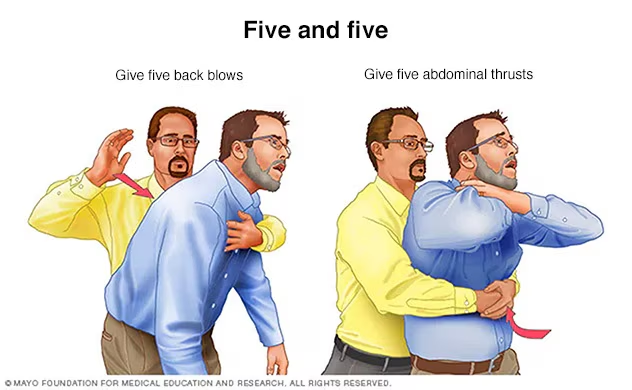
Back blows and abdominal thrusts are the correct response to a conscious adult with a severely obstructed airway. Current guidance calls for cycles of five back blows followed by five abdominal thrusts, with back blows as the opening step.
The moment the person becomes unresponsive, that phase is over. Standing techniques depend on an upright torso and cannot be performed effectively on someone collapsing to the floor. Lower them carefully to a firm flat surface and change approach entirely. Continuing to attempt thrusts on the ground burns the most valuable seconds available.
Mistake two: checking for a pulse
A lay rescuer does not check a pulse, in this situation or any other. Recognition rests on responsiveness and breathing, and both have already answered the question. You watched the airway obstruct and you watched the person lose consciousness.
Pulse checks are unreliable even among trained clinicians under pressure, and the seconds spent are seconds without compressions. Begin chest compressions immediately.
Mistake three: the blind finger sweep
This is the most instinctive error and the most damaging. The impulse to reach into the mouth and search for the object is powerful, and it can push a partially dislodged obstruction deeper and wedge it more firmly than before.
The correct action is narrow and specific. Each time you open the airway to deliver breaths, take a quick look inside the mouth. If the object is visible, remove it. If you cannot see it, do nothing and proceed with the breath. Look, do not feel.
Mistake four: defaulting to hands-only CPR
Compression-only CPR has been promoted heavily and correctly, because it saves lives in sudden cardiac arrest and it removes the hesitation that stops people acting at all.
A choking arrest is a different physiological event. The heart stopped because oxygen ran out, not the other way around, and by the time the person collapsed they had already been deprived for a period. Circulating blood that carries no oxygen achieves very little on its own. The 2025 guidelines recommend compressions combined with breaths here, for lay rescuers as well as clinicians, where the rescuer is willing and able.
If a breath does not make the chest rise, reposition the head with a tilt and chin lift and try again. Poor head position accounts for more failed ventilations than the obstruction does.
Mistake five: stopping when the object comes out
Clearing the obstruction is not the end of the emergency. If the person remains unresponsive and is not breathing normally, continue CPR. The obstruction was the cause; the arrest is the condition, and it does not resolve simply because the cause has been removed.
Anyone who lost consciousness from choking requires medical assessment even after an apparently full recovery, because aspiration and airway injury can develop over the following hours.
The underlying problem
Every one of these errors is a reasonable instinct applied at the wrong moment. Reaching into a mouth, checking for a pulse, stopping when the crisis appears to end — none of these are foolish. They are what an untrained person does under pressure, and reading about them is not enough to override them in the moment.
That gap only closes with rehearsal. The courses at Simple CPR cover choking response as part of CPR and first aid instruction, built on current resuscitation guidelines and structured to work around a schedule. The point of training is not to learn the sequence. It is to make the correct action arrive faster than the instinctive one.