



What to Look For in Bralette Tops Built for Dance
Most support garments on the market are designed around running, which involves repetitive vertical impact and very little else. Dance asks for something different, meaning full overhead extension, sustained inversion, floor work in every orientation, and rapid changes of direction, often within a single phrase. A garment engineered for one of those demands frequently fails at the others. This is why bralette tops made for dancers are constructed differently, and why a general activewear piece often disappoints in a studio.
The differences are visible in the construction if you know where to look.
Why Dance Places Different Demands on Support
The core problem is orientation. A running bra needs to control vertical movement while the wearer stays upright. A dancer spends meaningful time inverted, folded, and rotated, and a garment held in place primarily by gravity and shoulder tension will shift.
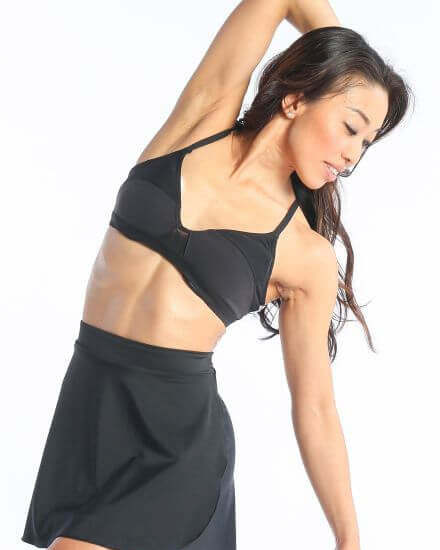
Sustained overhead work adds a second problem. Any design that relies on downward pull at the shoulder will ride up when both arms extend fully, and it will stay there.
The result is that support in dance comes primarily from the band rather than from the straps, which inverts the priority most shoppers apply.
The Band Does the Work
Check the underband first. This single element determines whether the garment stays put.
A wider band distributes pressure across more surface area, which is both more secure and more comfortable across a three-hour rehearsal. A narrow band concentrates pressure into a line, which rolls, digs, and shifts.
The band should sit firmly enough that it does not move when you raise both arms, but not so tight that it restricts rib expansion. Breathing matters, and a band that limits the ribcage will affect stamina in ways that are easy to misattribute to conditioning.
Test it by putting the garment on, raising both arms overhead, and holding for a slow count of ten. If the band travels upward, it is either too loose or too narrow.
Strap Configuration and Overhead Range
Straps in dance garments serve positioning more than load bearing, which changes what to look for.
Crossing and racerback configurations generally stay in place better than straight straps during overhead work, because they anchor across the back rather than balancing on the shoulder. The tradeoff is that they need to sit clear of the shoulder blades, since a strap crossing directly over the blade can restrict upper back mobility.
Check this specifically. Put the garment on and move through a full port de bras or a shoulder roll. Any sense of restriction across the upper back will become significant during class.
Adjustable straps are worth prioritizing for dancers still growing, since torso length changes faster than other measurements.
Coverage Through Inversions
This is the practical test that general activewear frequently fails.
A garment can feel secure standing and still shift during a shoulder stand, a backbend, or floor work. The only reliable check is to try the movements. Bend forward fully, invert if you can do so safely, and move through a floor sequence.
Look for a design where the band and the body of the garment work together rather than relying on the band alone. Longer-line styles that extend further down the torso generally provide more security through inversion than very short cuts.
Sizing Without Cup Sizes
Most dance bralettes use general sizing rather than band and cup measurements, which causes confusion.
Check the published measurements rather than the size label, and pay attention to underbust measurement specifically, since that is what the band has to fit. Chest measurement matters for coverage, but underbust determines security.
If a brand publishes torso length, use it. Dancers with long torsos are frequently sized incorrectly when only chest measurements are considered.
Size for the band being firm and the movement being unrestricted. A garment that is comfortable standing still but loosens during class was sized too generously.
Fabric and Construction
Check spandex content, which drives recovery, meaning the fabric’s ability to return to shape after repeated stretching. Higher content generally holds up through more wear cycles.
Look for flatlock seams, which lie smooth against the skin and resist splitting. Anything ridged will be noticeable during sustained floor contact.
Check whether the band elastic is encased in fabric rather than exposed. Encased elastic survives considerably more wash cycles and stays comfortable longer.
Wearing It Within a Dress Code
Most technique classes specify a leotard, and a bralette worn underneath needs to sit invisibly, meaning no straps crossing outside the leotard’s lines unless the code permits it.
Contemporary, commercial, and open rehearsal blocks are usually where bralettes are worn as outer layers. Read the written code rather than assuming, and check whether color is specified.
Building Your Rotation
Prioritize the band width, test the overhead hold, check upper back clearance, and size by underbust rather than by label. Keep three or four in rotation so elastic recovers between wears. Tiger Friday builds support pieces around the demands of actual training. Explore the collection to find what works.