



CPR for Adults, Children, and Infants: What Changes and Why
A parent who has completed a workplace CPR course often assumes the training transfers to their own children. It transfers partially. The underlying principle holds, meaning circulate blood and restore oxygen, but the technique differs at nearly every step, and applying adult technique to an infant can cause serious injury. Understanding cpr adult child infant differences is what turns general awareness into a response that is actually appropriate to the person in front of you.
The differences follow logically from anatomy and from cause, which makes them easier to retain than a list of numbers.
Where the Age Lines Fall
For resuscitation purposes, an infant is generally considered under one year of age. A child spans from one year to the onset of puberty. From puberty onward, adult technique applies.
The puberty boundary is deliberately imprecise, because it is based on physical development rather than a birthday. A large twelve-year-old is treated as an adult. In an emergency, do not spend time deliberating. Choose the closest match and begin.
Why the Cause Is Usually Different in Children
This single fact explains most of what follows.
Adult cardiac arrest is frequently cardiac in origin, meaning a sudden electrical or circulatory event in a heart that stops abruptly. Pediatric arrest is more often respiratory in origin, meaning the child stopped breathing first and the heart followed as oxygen depleted.
The practical implication is significant. In adults, circulating the already-oxygenated blood is the priority, which is why compression-only CPR is recommended for untrained bystanders. In children and infants, restoring oxygen matters more, which is why rescue breaths carry greater weight in pediatric response and why they should not be skipped if you are trained to deliver them.
Hand Placement and Compression Depth
Technique scales with body size.
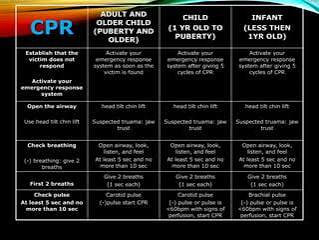
Adults receive two-handed compressions on the lower half of the breastbone, to a depth of about two inches.
Children typically receive one-handed compressions in the same location, though a smaller responder or a larger child may require two hands. Depth is roughly one third the depth of the chest, which works out to about two inches in most children.
Infants receive two-finger compressions just below the nipple line, or the two-thumb encircling technique when two responders are present. Depth is again about one third of chest depth, roughly one and a half inches.
The depth guidance is proportional rather than absolute, which is the useful way to remember it. One third of the chest, whatever that chest happens to be.
Compression Rate and Ratios
Rate is the one element that does not change. Compressions run at 100 to 120 per minute across all age groups.
Ratios do change with the number of responders. A single responder uses 30 compressions to 2 breaths for every age group. When two trained responders are present, the ratio shifts to 15 compressions to 2 breaths for children and infants, while remaining 30 to 2 for adults.
That shift reflects the greater importance of ventilation in pediatric arrest. When a second responder is available to deliver breaths without interrupting compressions, breaths are delivered more frequently.
Airway and Breathing Differences
Infant anatomy requires a lighter touch. Tilting an infant’s head too far back can actually obstruct the airway rather than open it, so the head is placed in a neutral position rather than the pronounced tilt used for adults.
Breath volume scales down substantially. For an infant, a rescuer covers both the mouth and nose with their mouth and delivers small puffs, enough to produce visible chest rise and no more. Excessive volume forces air into the stomach and can cause vomiting.
The principle is consistent across ages. Watch the chest, stop when it rises.
Using an AED on a Child or Infant
Hesitation here is common and costly. Defibrillators can and should be used on children and infants when indicated.
Many devices include pediatric pads or a pediatric setting that reduces the energy delivered. Use these when available for children under eight or under roughly twenty-five kilograms. When only adult pads are available, use them rather than withholding treatment. Place one pad on the chest and one on the back if the pads would otherwise touch on a small torso.
An AED will not deliver a shock to a rhythm that does not warrant one, which is worth knowing when the instinct is to hesitate.
What Stays the Same
Recognition, calling for emergency help, compression rate, minimizing interruptions, and continuing until the person recovers or trained help arrives. These are constant regardless of age.
Learning the Technique Properly
Reading the differences builds understanding. Developing correct depth and hand position for a body that is not adult-sized requires supervised practice, and that is not something an article provides.
For parents, caregivers, and childcare staff ready to train, Simple CPR offers courses covering all three age groups and AED use. Visit the site to find a course that fits your schedule.