


Choosing the right commercial fence contractors is an important decision for any business owner planning to install, replace, or upgrade a commercial fence. The right contractor does more than simply install posts and panels—they help you select suitable materials, understand property requirements, plan for security and privacy, and complete the project safely and professionally.
Whether you need fencing for a warehouse, office building, retail property, industrial facility, parking lot, school, or other commercial space, selecting an experienced contractor can make a significant difference in the fence’s durability, appearance, and long-term value.
This guide explains what to look for when comparing commercial fencing contractors and the questions you should ask before signing a contract.
Why Choosing the Right Commercial Fence Contractor Matters
Commercial fencing often has different requirements than residential fencing. A business may need a fence to control access, protect equipment, secure inventory, improve privacy, define property boundaries, or create a safer environment for employees and visitors.
A poorly planned installation can result in:
- Unstable fence posts
- Premature rust or corrosion
- Improper gates
- Security vulnerabilities
- Drainage and grading problems
- Property-line disputes
- Unexpected repair costs
- Delays that interfere with business operations
An experienced commercial contractor should understand these challenges and recommend a fencing solution based on your property’s specific needs.
1. Look for Commercial Fencing Experience
One of the first things to evaluate is whether the contractor has experience with commercial projects, rather than primarily residential installations.
Commercial properties can involve larger areas, specialized gates, access-control requirements, heavier-duty materials, and more complicated site conditions.
Ask potential contractors:
- How many commercial fencing projects have you completed?
- Have you worked on properties similar to mine?
- Can you provide examples of previous commercial installations?
- Do you handle large-scale fencing projects?
- Are you familiar with commercial access gates and security requirements?
A contractor with relevant experience is more likely to anticipate potential challenges before installation begins.
2. Check Licensing, Insurance and Credentials
Before hiring a contractor, verify that the company has the appropriate licenses, registrations, and insurance required for your location and type of work.
Insurance is particularly important for commercial projects. Ask whether the contractor carries:
- General liability insurance
- Workers’ compensation insurance
- Appropriate vehicle or equipment coverage
You should also ask for documentation when appropriate rather than relying solely on verbal assurances.
Proper credentials help protect your business from unnecessary liability if an accident, property damage, or other issue occurs during the project.
3. Review Their Previous Commercial Projects
A contractor’s previous work can tell you a lot about their capabilities.
Ask to see photographs or examples of completed projects involving similar fencing materials, property sizes, and applications.
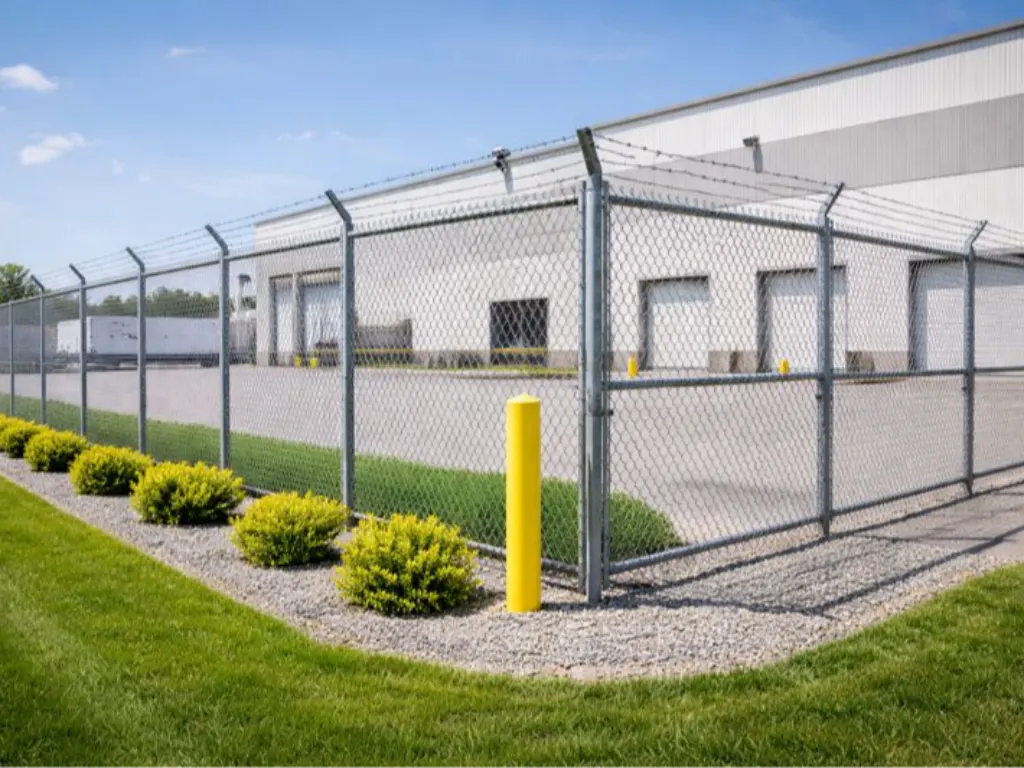
For example, if you are securing a warehouse, look for contractors who have experience with:
- Industrial properties
- Chain-link fencing
- Security fencing
- Large access gates
- Perimeter fencing
If your property is an office complex, you may want examples involving:
- Aluminum fencing
- Decorative fencing
- Privacy fencing
- Pedestrian gates
- Parking-area fencing
Previous projects can help you determine whether the contractor’s workmanship and design approach fit your expectations.
4. Understand Your Business’s Security Requirements
Not every commercial property needs the same level of security.
Before discussing specific fencing materials, determine what you want the fence to accomplish.
For example, your priorities might include:
Basic property definition:
A fence may primarily establish a clear boundary around the property.
Privacy:
A privacy fence can help prevent people outside the property from seeing equipment, operations, storage areas, or employees.
Access control:
Gates and controlled entry points can help manage who enters and exits the property.
Asset protection:
Industrial and warehouse properties may require stronger perimeter protection to safeguard equipment, materials, and inventory.
Safety:
Fencing can help separate pedestrians from vehicles, machinery, loading areas, or other potentially hazardous zones.
Once you understand the primary purpose, your contractor can recommend an appropriate fencing system.
5. Compare Different Commercial Fence Materials
A reputable contractor should be able to explain the advantages and limitations of different materials instead of automatically recommending one option.
Chain Link Fencing
Chain link is widely used for commercial and industrial applications because it offers durability, visibility, and relatively straightforward installation.
It can be suitable for:
- Warehouses
- Construction sites
- Industrial properties
- Utility areas
- Storage facilities
- Large perimeter areas
Privacy slats or screening can also be added when greater visual separation is needed.
Aluminum Fencing
Aluminum can provide a more polished appearance while offering resistance to corrosion.
It can work well for:
- Office properties
- Commercial entrances
- Schools
- Apartment complexes
- Retail properties
Aluminum fencing can provide security while maintaining an attractive appearance.
Steel Fencing
Steel can be appropriate when strength and durability are major priorities.
It may be considered for properties requiring more robust security or heavy-duty applications.
Wood Fencing
Wood can provide privacy and a traditional appearance. It may be appropriate for certain businesses where aesthetics and privacy are more important than maximum security.
However, wood requires more maintenance than some metal fencing options.
6. Ask About Gates and Access Control
A commercial fencing project should not be evaluated only by looking at the fence itself.
Gates are often one of the most important parts of a commercial security system.
Depending on your property, you may need:
- Pedestrian gates
- Vehicle gates
- Sliding gates
- Swing gates
- Drive-through gates
- Automated gates
- Access-control systems
Consider how employees, customers, delivery vehicles, emergency personnel, and contractors will enter and leave the property.
Ask the contractor how the proposed gate system will integrate with your existing access-control setup, if applicable.
7. Confirm That the Contractor Will Evaluate the Property
A professional contractor should understand that every commercial property is different.
Before providing a final recommendation, they may need to evaluate:
- Property dimensions
- Terrain
- Existing structures
- Driveways
- Utility locations
- Drainage
- Existing fencing
- Gate locations
- Property boundaries
- Access requirements
A site evaluation can identify potential installation problems before construction begins.
Be cautious of contractors who provide a detailed final quote without properly understanding the property.
8. Discuss Property Lines and Permits
Property boundaries are especially important when installing commercial fencing.
Before installation, make sure you understand exactly where your property begins and ends. Depending on the project and location, you may also need permits or approvals.
Your contractor should be able to explain what requirements apply to their portion of the work and whether additional professionals or authorities need to be involved.
If there is uncertainty about the property line, it may be appropriate to consult a qualified surveyor before installation.
Getting this right from the beginning can help prevent costly disputes later.
9. Compare Detailed Written Estimates
Don’t compare contractors based solely on the total price.
Ask each contractor to provide a detailed written estimate that explains what is included.
The estimate should ideally identify:
- Fence material
- Fence height
- Approximate linear footage
- Number and type of gates
- Posts and hardware
- Installation labor
- Removal of existing fencing
- Site preparation
- Permit-related costs, if applicable
- Cleanup
- Warranty information
- Additional charges or potential exclusions
A low quote may not actually be cheaper if important services or materials are excluded.
Instead of asking, “Who is the cheapest?”, ask, “What exactly am I getting for this price?”
10. Don’t Ignore Installation Quality
Even high-quality fencing materials can fail prematurely when they are installed incorrectly.
Installation quality can affect:
- Fence stability
- Post alignment
- Gate operation
- Drainage
- Appearance
- Resistance to weather
- Long-term maintenance requirements
Ask the contractor how they install posts, handle uneven terrain, and address challenging soil or site conditions.
You should also ask how they plan to maintain consistent fence height and alignment across the property.
11. Ask About Project Timeline
Commercial fencing projects can sometimes interfere with normal business operations.
Before work begins, ask:
- When can the project start?
- How long is installation expected to take?
- Will work occur during business hours?
- Will access to the property be restricted?
- How will deliveries and employees enter the property during installation?
- What happens if weather causes delays?
A clear project schedule helps you plan around construction and minimize disruptions.
For larger projects, you may also want the contractor to provide a project schedule with major installation stages.
12. Evaluate Communication and Customer Service
A contractor’s communication before the project can be a useful indicator of what to expect during installation.
Pay attention to whether they:
- Answer questions clearly
- Arrive on time
- Provide documentation
- Explain recommendations
- Respond promptly
- Keep commitments
- Communicate potential problems early
If a contractor is difficult to communicate with before signing the contract, managing the project later may become even more challenging.
13. Read Reviews and Check References
Online reviews can provide useful insight into a company’s reliability and customer service.
However, don’t rely exclusively on star ratings.
Look for recurring comments about:
- Workmanship
- Professionalism
- Communication
- Project completion
- Fence quality
- Cleanup
- Responsiveness to problems
For larger commercial projects, consider asking for references from previous business customers.
If possible, speak with previous customers about their experience from the initial estimate through project completion.
14. Ask About Warranties and Maintenance
Before signing a contract, understand what warranties are provided.
Ask whether the warranty covers:
- Materials
- Installation workmanship
- Gates
- Hardware
- Finishes or coatings
Also ask what situations might void the warranty.
Maintenance requirements should be discussed as well. Different materials can have different long-term maintenance needs.
Understanding these costs upfront makes it easier to calculate the true long-term value of your fencing investment.
15. Consider Long-Term Value, Not Just Initial Cost
The cheapest fence isn’t necessarily the most cost-effective option.
A better way to evaluate a commercial fencing project is to consider its total value over time.
For example:
Initial cost + maintenance + repairs + expected service life = long-term cost
A more expensive material may potentially offer better durability or lower maintenance requirements, depending on the application.
Your contractor should help you balance:
- Budget
- Durability
- Appearance
- Security
- Maintenance
- Expected lifespan
This approach can help you avoid choosing a fence based solely on the lowest initial bid.
Questions to Ask Commercial Fence Contractors
Before hiring a contractor, consider asking these questions:
- How much commercial fencing experience do you have?
- Have you completed projects similar to mine?
- Are you properly licensed and insured?
- Can you provide references?
- What fencing materials do you recommend and why?
- What type of gate would work best for my property?
- Will you inspect the property before providing the final estimate?
- Who is responsible for permits?
- How long will installation take?
- What is included in the quoted price?
- Do you remove existing fencing?
- What warranty do you provide?
- What maintenance will the fence require?
- How will unexpected site conditions affect the cost?
- How will construction affect normal business operations?
The answers can help you distinguish between contractors who simply provide a price and those who take the time to understand your project.
Commercial Fence Contractor Comparison Checklist
| Factor | What to Look For |
| Experience | Previous commercial projects |
| Insurance | Appropriate liability and workers’ compensation coverage |
| Materials | Multiple suitable options |
| Site assessment | On-site evaluation before installation |
| Estimate | Detailed written proposal |
| Gates | Appropriate access and security options |
| Permits | Clear understanding of applicable requirements |
| Installation | Professional workmanship |
| Timeline | Realistic project schedule |
| Warranty | Clearly explained coverage |
| Reviews | Consistent positive customer feedback |
| Communication | Prompt and professional responses |
| Maintenance | Clear expectations after installation |
Common Mistakes Businesses Make When Hiring a Fence Contractor
Choosing the Lowest Quote
Price matters, but an unusually low quote may indicate that certain materials, services, or project requirements have been left out.
Focusing Only on the Fence Material
A high-quality material cannot compensate for poor installation. Evaluate both the product and the contractor’s workmanship.
Not Planning Gate Access
A fence without properly planned gates can create operational problems for employees, customers, and delivery vehicles.
Skipping the Site Assessment
Existing structures, terrain, utilities, drainage, and property boundaries can affect the installation.
Not Getting Everything in Writing
Always make sure pricing, materials, timeline, warranties, and project responsibilities are clearly documented.
Final Thoughts
Choosing the right commercial fencing contractor is about more than finding someone who can install a fence. The right contractor should understand your property’s security needs, recommend suitable materials, plan practical access points, provide a transparent estimate, and deliver quality installation.
Take time to compare experience, credentials, materials, reviews, warranties, pricing, and communication before making your decision. A well-planned commercial fence can provide security, privacy, property definition, and lasting value for your business.
If you’re planning a commercial fencing project in Philadelphia, SuperFenceCo can help you evaluate your fencing requirements and find a solution suited to your commercial property. From material selection to professional installation, working with an experienced fencing company can make the entire process more straightforward and reliable.
