



When choosing corrugated shipping boxes, getting the measurements right is essential for protecting products, controlling shipping costs, and avoiding wasted packaging materials. A box that is too small can crush or damage its contents, while an oversized box may require excessive void fill and increase dimensional shipping costs.
The good news is that measuring a corrugated box correctly is straightforward once you know which dimensions to measure and where to start.
This guide explains how to measure a corrugated shipping box, how manufacturers list box dimensions, the difference between inside and outside measurements, and common mistakes to avoid.
What Are the Dimensions of a Corrugated Shipping Box?
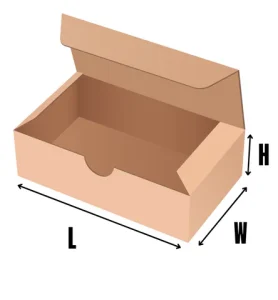
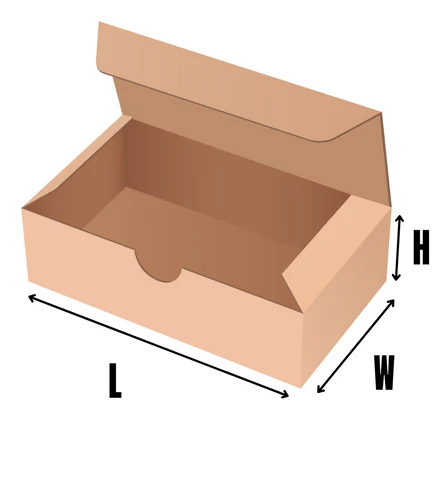
Most corrugated boxes are described using three measurements:
Length × Width × Height (L × W × H)
For a standard rectangular shipping box:
- Length is the longest side of the box opening.
- Width is the shorter side of the opening.
- Height is the distance from the opening to the opposite panel when the box is assembled.
For example, a box listed as 18″ × 12″ × 10″ generally means:
- Length: 18 inches
- Width: 12 inches
- Height: 10 inches
However, there is an important detail: box dimensions may refer to either inside dimensions or outside dimensions. Understanding which measurement you’re looking at is critical when selecting packaging.
How to Measure a Corrugated Shipping Box Step by Step
Step 1: Open and Assemble the Box
If you’re measuring an existing flat box, first open it and form it into its normal shape.
For an accurate measurement, make sure:
- The box is fully opened.
- The panels are properly aligned.
- The bottom flaps are folded into their normal position.
- The box is not crushed, bent, or distorted.
- You are measuring the box in the form in which it will actually be used.
Trying to measure a flattened box can produce inaccurate results.
Step 2: Identify the Length
Start with the longest side of the box opening.
Place your measuring tape along the inside of the box from one interior end to the other.
This measurement is the length.
For example, if the longest interior side measures 16 inches, the box length is approximately 16 inches.
Tip: Don’t measure diagonally. Measure straight across the inside of the box.
Step 3: Measure the Width
Next, measure the shorter side of the box opening.
Place the measuring tape from one interior side panel to the opposite interior side panel.
This is the width.
For example:
Length = 16 inches
Width = 12 inches
At this point, you have the first two measurements.
Step 4: Measure the Height
Finally, measure the vertical distance from the bottom of the box to the top opening.
This is the height.
For an assembled box, measure from the inside bottom panel to the inside top edge.
For example:
16″ × 12″ × 10″
means the box has:
- 16-inch length
- 12-inch width
- 10-inch height
Should You Measure the Inside or Outside of the Box?
This is one of the most important considerations when measuring corrugated packaging.
Inside Dimensions
Inside dimensions tell you how much usable space is available for your product.
They are especially useful when you’re trying to determine whether a particular item will fit inside the box.
For example, if your product measures:
15″ × 11″ × 9″
you need to make sure the box’s interior dimensions provide enough room for:
- The product
- Protective materials
- Cushioning
- Wrapping
- Other packaging components
Outside Dimensions
Outside dimensions measure the box from its exterior edges.
These measurements can be important when calculating:
- Storage requirements
- Pallet utilization
- Truck space
- Warehouse capacity
- Shipping dimensions
- Dimensional weight
Because corrugated board has thickness, the outside dimensions will generally be slightly larger than the inside dimensions.
Which One Should You Use?
For most product-fitting decisions, inside dimensions are the most useful starting point.
For transportation, storage, and shipping calculations, you may need to consider outside dimensions, depending on the carrier’s requirements.
Always check how a supplier defines its listed dimensions before ordering.
Why Box Measurements Matter for Shipping Costs
Choosing the correct box size isn’t only about making sure your product fits.
Box dimensions can also affect your shipping costs.
Carriers may use dimensional weight, which considers the amount of space a package occupies rather than simply its actual weight.
A simple dimensional-weight calculation generally looks like:
Length × Width × Height ÷ Dimensional Factor = Dimensional Weight
The exact dimensional factor and billing rules vary by carrier and service.
That means shipping a small, lightweight product in an unnecessarily large box could result in higher shipping charges.
Example
Imagine you are shipping a lightweight product that fits comfortably in a:
12″ × 8″ × 6″ box
Instead, you use a:
20″ × 16″ × 12″ box
The second box takes up considerably more space even if the product weighs the same.
Using an appropriately sized box can therefore help reduce unnecessary dimensional volume.
Don’t Forget Space for Protective Packaging
One common mistake is measuring only the product and selecting a box with exactly the same dimensions.
Your product usually needs some additional space for protective packaging.
Depending on what you’re shipping, you might use:
- Bubble cushioning
- Foam
- Paper void fill
- Air pillows
- Kraft paper
- Corner protection
- Product sleeves
- Inserts
For example, if your product is 12″ long, a 12-inch interior box may not be sufficient if you need cushioning around both ends.
Instead, account for the required protective space when selecting your box.
How Much Extra Space Should You Leave?
There isn’t one universal amount of extra space because the appropriate clearance depends on:
- Product fragility
- Cushioning material
- Product shape
- Shipping distance
- Handling conditions
- Box strength
- Packing method
A fragile product may need significantly more protective space than a durable item.
The goal isn’t to leave as much empty space as possible. Instead, aim for enough clearance to protect the product without creating excessive void space.
How to Measure a Box for a Product
If you’re trying to determine which box size you need, start with the product rather than the box.
1. Measure the Product Length
Measure the longest dimension of the product.
2. Measure the Product Width
Measure the next-longest dimension.
3. Measure the Product Height
Measure the remaining dimension.
4. Account for Protection
Determine how much space your cushioning or protective packaging requires.
5. Add the Required Clearance
Add the necessary space around the product.
6. Select the Closest Suitable Box
Choose a box that provides adequate interior space without being unnecessarily oversized.
How to Measure Irregularly Shaped Products
Not every product fits neatly into a rectangular measurement.
Items such as:
- Lamps
- Tools
- Appliances
- Sculptures
- Equipment
- Furniture components
may have irregular shapes.
In these cases, identify the product’s maximum length, width, and height.
Imagine placing the product inside a rectangular container. Measure the maximum dimensions that the container would need to accommodate.
Then account for cushioning and other protective materials.
For particularly unusual products, creating a simple mock-up using temporary packaging can help you determine the appropriate box dimensions before purchasing packaging in bulk.
How to Measure a Corrugated Box for Dimensional Weight
If your goal is to calculate shipping costs, measure the fully packed package, not just the empty box.
Your final package dimensions can change depending on:
- How the product is positioned
- How much cushioning is used
- Whether the flaps extend outward
- How the box is sealed
- Whether the package bulges
- The final exterior dimensions
Measure the completed package at its maximum length, width, and height according to the applicable carrier’s measurement rules.
This is especially important for e-commerce businesses shipping large numbers of packages.
Common Mistakes When Measuring Corrugated Boxes
1. Measuring the Box While It’s Flattened
A flat box doesn’t represent its final usable dimensions.
Always assemble the box before taking interior measurements.
2. Confusing Length and Width
For standard rectangular boxes, length is generally the longest dimension of the opening, followed by width.
However, always check the supplier’s dimension convention.
3. Ignoring Board Thickness
Inside and outside dimensions aren’t identical because corrugated board has thickness.
Don’t assume a box’s advertised dimensions automatically represent its usable interior space.
4. Forgetting Protective Material
A product may technically fit inside a box but have no room for cushioning.
This can leave the item vulnerable to impact damage.
5. Choosing a Box That’s Too Large
An oversized box can:
- Increase void fill requirements
- Increase package volume
- Increase dimensional weight
- Allow products to move during transit
- Increase material usage
6. Measuring Only One Box
If you’re ordering packaging for business use, check several samples when possible.
Manufacturing tolerances, board thickness, and box construction can create small variations.
7. Ignoring Box Style
Different box styles can have different usable interior spaces even when their overall dimensions appear similar.
Always consider the actual construction of the box.
Inside Dimensions vs. Outside Dimensions: Quick Comparison
| Measurement | What It Tells You | Best Used For |
| Inside length | Usable internal length | Product fit |
| Inside width | Usable internal width | Product fit |
| Inside height | Usable internal height | Product fit |
| Outside length | Exterior package length | Shipping/storage |
| Outside width | Exterior package width | Shipping/storage |
| Outside height | Exterior package height | Shipping/storage |
When purchasing packaging, ask the supplier whether the listed measurements represent inside dimensions, outside dimensions, or the manufacturer’s standard box dimensions.
What Does “Inside Dimension” Mean on a Box Listing?
When a packaging supplier lists a box as 18″ × 12″ × 10″ inside dimensions, it means the usable internal cavity is designed to accommodate products within those approximate dimensions.
This is particularly helpful when you are standardizing packaging for an e-commerce operation.
For example, if you frequently ship products measuring approximately 16″ × 10″ × 8″, you can identify a box size that accommodates the product while leaving sufficient room for protective packaging.
How to Measure a Box for Storage
Shipping isn’t the only reason to measure packaging correctly.
If you’re storing empty boxes in a warehouse, you’ll want to consider their flat dimensions and assembled dimensions.
Flat-box measurements help determine:
- Shelf requirements
- Storage racks
- Pallet quantities
- Warehouse space
Assembled measurements help determine:
- Product capacity
- Packing stations
- Finished-package storage
- Shipping space
Businesses that use large quantities of packaging should consider both.
How Accurate Do Your Measurements Need to Be?
For general packaging selection, measuring to the nearest 1/8 inch or 1/4 inch can provide useful precision.
For shipping calculations, however, follow the specific carrier’s measurement and rounding rules.
Don’t assume that a measurement such as 12.2 inches will always be treated as 12.2 inches. Carriers may apply their own rounding policies.
If you’re calculating shipping costs at scale, verify the current requirements of your shipping carrier.
A Simple Box Measurement Example
Suppose you need to ship a product that measures:
- Length: 14 inches
- Width: 9 inches
- Height: 6 inches
You also need protective cushioning around the product.
You wouldn’t necessarily want a box with exactly 14″ × 9″ × 6″ interior dimensions because the cushioning would have nowhere to go.
Instead, determine the clearance required by your chosen protective material and select a box with sufficient interior space.
The objective is:
Product dimensions + protective space = required interior box dimensions
Then choose the closest standard box that meets those requirements.
Quick Checklist for Measuring Corrugated Shipping Boxes
Before ordering or using a box, check:
- What are the inside dimensions?
- What are the outside dimensions?
- Which dimension is length?
- Which dimension is width?
- Which dimension is height?
- Will the product fit comfortably?
- Is there enough room for cushioning?
- Is the box unnecessarily oversized?
- Will the final package dimensions affect dimensional weight?
- Is the box strong enough for the product’s weight?
- Does the box style provide enough usable space?
- Are you following your carrier’s measurement requirements?
Final Thoughts
Measuring a corrugated box correctly is a simple step that can have a significant impact on product protection, packaging efficiency, storage, and shipping costs. Start by identifying the length, width, and height, determine whether you’re working with inside or outside measurements, and always account for protective materials before selecting your final box size.
For businesses that regularly ship products, choosing the right packaging can help create a more efficient and consistent fulfillment process. Starboxes offers packaging solutions that can help businesses find suitable boxes and shipping materials for a wide range of packing needs.
The right box isn’t simply one that fits your product—it’s one that provides the right balance of protection, space, strength, and shipping efficiency.